Showing posts with label literary pretension. Show all posts
I have taken a bizzarely Randian turn for the past few days, which is odd considering:
  1. Rand is a nut
  2. See one.
Nevertheless. It started on being at the docs today, and taking in quite how much resources and effort will have to go towards getting me healthy. In any other country or any other time - or with any other fortune - this wouldn't be possible. Do I deserve to be better; if I can't get better, do I deserve to live? This is more philosophical than pragmatic, but still - what am I contributing to society which justifies such input?

The thought continued while watching "Baby Animal Planet" for solace. Awwww, Lucy the baby lion being raised as if she was a kitty. The show ended with the narrator claiming that Nature wanted "the survival of all species". That's bunk - survival of the fittest, surely. And I got to thinking about endangered species, and how nice of us it is to save them, and how ultimately pointless. If you're an African Wader with a silly breeding strategy, of course you don't stand a chance. We forget: we wiped out our wildlife centuries ago, so as endearing as orangutans are should they not be cleared in the way of progress, as we did our black bears and native wolves? Let's invite the wolverines and wooly mammoths back while we're at it!

And finally, to language. Why do we save language? I'm divided, even as I collect zombie languages to learn. In the next 10 years, 90% of the world's languages shall die out - they will remained like stuffed animals, museum pieces. Of course, their contents must be preserved but...saving languages like Guernsey French is a happy-Tory, Green And Pleasant Land, home-jam-making sort of idea. Because it's so nice, and we can wheel it out once a year with the bonnets, and the weaving, and the beanjar and can-making; and forget that plastic is superior to copper milk cans, and that the bonnets are made from synthetic materials, and that nobody actually likes bean jar - it's just, y'know, traditional.

Part of me says that. Loudly. I can now say "hello, how are you doing?", in a language no one can reply to. Brilliant!

At the same time, words are the expression of a people. A book in translation is necessarily different from it's original. And Guernsey French has a word for a cat's fur, ruffled the wrong way; and a verb for "touching food with hands which might not necessarily be clean"; and one for a certain note in the song of a songthrush. Pointless. Priceless.

I'm excited by a future when everyone speaks the same language (especially if it's English, and i don't have to do any more work). We'll be able to exchange those ideas and concepts encoded in our national languages and achieve world peace. At the same time, how can we preserve those ideas at all if we do not have the words?

A la perchoine!
Best Hamlet ever.

I mean, he's not "my Hamlet", not wholly. If I could act, and the stage was mine, then my Hamlet would be ruthlessly intelligent, incisive, cruel, a scholar out of his depth in events he couldn't rationalise, and always, the only person laughing at his own jokes. And also, a pretty, gangly indie-boy of some sort. I'm not sure Rory Kinnear would obviously tick any of those boxes - he doesn't even find his jokes funny - and perhaps that's indicative of the differences between how Hamlet is percieved as a character, and how he is on the page.

I've just been to the National Theatre, within spitting-distance of the stage, and am about to give a nauseatingly positive review. I'm also about to try and defend that statement above, which wasn't true until I started writing, and discovered it absolutley was.

Often in Hamlet, an individual scene will fail because it just doesn't gel with the actor's interpretation. They'll be subtle, upset, cold - the early scenes offer an almost unlimited range. Unfortunately, that's not true of the second act, so you'll get them suddenly ramping up to 200MPH because the script seems to demand anger - the nunnery, the closet, and the crocodile scenes particularly. It seems jarring and forced in comparison to what has come before.

The graveside most of all: Hamlet has just come back from England in disguise and stumbled on Ophelia's funeral. He abandons his secrecy to pick a fight with Laertes, her brother, because he's pissed off that Laertes is sad. It's inconsiderate - of course Laertes is unhappy that his sister is dead. It's unmotivated - who exactly is he angry at here? It doesn't necessarily tally with the information we've been given - like, no other evidence at all that he cares for Ophelia at all. It's unforgiveably rude - Hamlet has killed Laertes' father, and also been the two chief factors in Ophelia's death. Plus, it's a weird scene which involves the two leads leaping into a grave and playing tug-o-war over a body, with one of them claiming he could eat a crocodile like it's the biggest boast of manliness instead of just a bizzare mental image.

In short, it always makes Hamlet look like a shit and it always comes off as out of character and weird. And that's the problem with gangly indie-boys - unless that's already a note in their character, they seem out of it. Not Kinnear. He's just so unhappy and angry, pain and supressed rage all the way through, that for the first time ever, this scene hasn't seemed terrible in every way. Instead, Laertes just becomes a cathexis for his misdirected rage, just as Polonius, Ophelia and Gertrude have in those other awkward scenes. And they all work so well because those other, early scenes in which others have depicted him struggling to cope merely with despair, he was trying to find a way to bear his anger. Indeed, I'd go as far as to say that the soliloquies were for once the weak spots, compared to how wonderful the ensemble scenes were. Even "oh, what a rogue and peasant slave am I!", where it is textual fact that Hamlet flies into a rage at himself, and then is ashamed of his inability to control his emotions, too often comes off as the exception (I'm suddenly ANGRY! And now normal service has been resumed) instead of the rule (I'M ANGRY I'M ANGRY, AND SUDDENLY I'M SO ANGRY I CAN'T COPE AAAAAAAAAAAAAAAAAAAAAAA CALM - I'M JUST ANGRY).

This doesn't make it in any way one-note, I mean this is a properly awesome and subtle rage that works alongside the character's melancholy, and intelligence, and humour, but that also works textually without having to jettison anything as part of a perfect character. And that makes the show as a whole more downbeat, because you are never in any doubt of just how much pain he is in. He has the most wonderful fake smile that's almost worse: the humour is properly humourless. A few people tried laughing at the gravediggers' scene, but only because they thought they should.

It's also the first time in some time I've seen a properly cracky Hamlet, and this also works. I like subtle Hamlets, but it's always too obvious that they are calculating and sane - the jokes too funny, the audience too in cahoots in comparison with the oblivious fellow characters. Many Hamlets are just too civilised to "go full retard"; and also, to be properly evil. I rarely believe it when he coldly sends Rosencrantz and Guildenstern off to their deaths, but this production in particular he's unreasonable enough that I understand why it would seem reasonable.

With all that seething anger, you'd wonder how he managed to stretch revenge out to 3-hours-30, so it's time to introduce this production's other ace: the design. Aaaah, beautiful - almost chronologically, I've seen more and more emphasis put on the paranoia of Elsinore, and this is the best I've ever seen. A band of suited security men haunt the stage; in the background during soliloquies, hanging about when Hamlet is trying to talk plans with friends. He is constantly being watched, guarded or followed, and the same is true of the Ophelia and everyone else. The stark sets were topped off with CCTV cameras. The oft-cut scene where Polonius engages Reynaldo to go to France and spy on his son seemed suddenly at home in this horrific context. It's clearly impossible for Hamlet to get anywhere near Claudius.

In fact, this production seems to have addressed my usual quibbles with an almost terrifying accuracy. In the second act, they pack Hamlet off stage for about eight scenes. He's such a driving force, and the scenes he's absent for are so...unspecial, that I never really enjoy Act II as much. Laertes returns and shouts, Ophelia spends two awful scenes going mad, Gertrude delivers an overly-famous speech which always seems forced, and then there's the crocodile scene.

It zipped by! That was helped by the most perfect, wonderful Laertes - a character who too often defaults to "prat", and is then an irritating companion the entire time our hero is out of the way. I can't put my finger on what was so special about this one. Perhaps because Hamlet was so angry, Laertes couldn't be, I don't know. He came across as very sincere, properly sympathetic - a nice, straightforward guy who's completely gullible. A perfect Laertes went some way towards diminishing my Act II boredom.

The same can almost be said of Ophelia, almost. She was one of the best I have ever seen - not sanctimonious, and realistically cowed into misery by the oppressive castle atmosphere. I am now entirely convinced, however, that Ophelia is unplayable and the weakest element of an otherwise watertight play. She has no development, she's very difficult for any sane feminist to approach and totally lacks psychological realism. The relationship between her and Hamlet is a textual black hole, and we have to believe she goes properly nuts just because all her male authority figures have been taken away.

One of the remarkeable things about Shakespeare is how sophisticated and universal his writing is. His dialogue actually contains psychological depth, centuries before the actor's method was invented. Ophelia is a big exception to this: the pathos of the virgin maid singing bawdy pastorals is a 16th century sort of understanding of the human brain. When Hamlet explains:
I have of late--but wherefore I know not--lost all my mirth, forgone all custom of exercises; and indeed it goes so heavily with my disposition that this goodly frame, the earth, seems to me a sterile promontory, this most excellent canopy, the air, look you, this brave o'erhanging firmament, this majestical roof fretted with golden fire, why, it appears no other thing to me than a foul and pestilent congregation of vapours. What a piece of work is a man! how noble in reason! how infinite in faculty! in form and moving how express and admirable! in action how like an angel! in apprehension how like a god! the beauty of the world! the paragon of animals! And yet, to me, what is this quintessence of dust? man delights not me.
I'm sure we've all had days like that. And it struck me now, more than ever, how perfect so many of Hamlet's descriptions of despair are. I've never seen someone express mental illness through tragic, accusing folk tunes before - the scenes are awkward to play because they're awkwardly written, and Ophelia is treated like some sort of reverent, knowing symbol of something throughout. No, the sound of a sweet voice singing is not enough to bring me to tears. Or move me. Or anything. "Here, have a metaphor!"

Which is why I'm kinda glad they neutralised the stomach-turning description of the world's most beautiful suicide by having Ophelia secretly dragged off by security guards, and Gertrude aware that Claudius arranged to have her done away with. It was fun to see Claudius played as a downright villain again - I like him sympathetic, but this was a nice change. Rosencrantz and Guildenstern too where pretty nasty pieces of work - this too made sense in context. Gertrude was the modern performance you recognise of a frazzled career woman clutching a red wine - very good. I particularly enjoyed the closet scene - she becomes hysterical at the moment Polonius is killed and remains so for that reason because that's what murders to do people. It's so easy for the actors to forget the corpse...and I now think, in contrast with Ophelia, Polonius is impossible to play badly, perhaps because it's always the most experienced actor on stage taking on a pretty easy role. Downsides? Horatio. Wasn't special, and delivered the lines as if they were Sha-hakes-speah, but you can't win them all.

Onto the specifics: the ghost scenes are just splended! Very creepy - the actor sounded like he had reverb or something, but I knew he didn't. And spoke very quietly, but seemed to boom at the same time - most special. Hamlet's small shadow, as he slumped at the corner of the stage, dwarfed by his father's huge one. Hamlet just crying, as well you might, while the Ghost explained the circumstances of his death. And actually, every time the Ghost walked across stage, and you could see him there white against the darkness, before the lights acknowledged he was there: creepy! I've already mentioned Ophelia's unusual death; I also enjoyed the opening scene with her family, which got the level of tenderness just right - her laugh at Laertes' awkward chastity speech, Polonius pausing uncomfortably as he extols the virtues of truth. And I loved Hamlet discovering a mike hidden inside her book, and dictating to it. The closet scene featured Gertrude able to see the ghost, but lying about it: what a wonderful choice!

In fact, there's only one bad thing about this one, and that's a pretty crass attempt to sell T-shirts half way through. But let's not think about that.

Instead, let's focus on the fact that I may just have seen a perfect Hamlet. So many of my quibbles were addressed, and the tedium of the second half almost totally evaporated. Any criticism I could have left should be aimed at the play itself. Which I've fallen in love with, all over again, with a funny feeling that Mr Kinnear has just fundamentally altered the way I see it...
I dropped into the Mediatheque for a laugh last night, and recieved some food for thought. The Mediatheque is a sort of youtube for film buffs, on site at the BFI. You pop into a booth, and a odd selection of cinema is your oyster - from TV and shorts, to PSAs and full movies. Frustratingly, it is almost always the final episode of any series, but whatever.

There was a perhaps unsurprising lack of comedy, with the most interesting item a series of short, 1900s movies about hilarious Jews. Which you would think would really interest me, considering the wealth of offensive material hidden at the back of my wardrobe, but I think something about filmed oppression freaks me out. I found the Black and White Minstrel show deeply disturbing, and had to turn it off, but can't apply the same visceral horror to the various homophobic/racist pamphlets I collect.

So I watched a bit of Carry on Camping, and then the underwhelming Five Go Mad in Dorset (merely stating the facts of what you are parodying in a context when you're meant to laugh isn't any funnier than just presenting what you are parodying). And then found Are You Being Served?, which was just the type of thing I'd hoped for.

Very daft, quite marvellous, I've a crush on Mr Lucas that's some four decades out of date. But I was interesting to read the notes. The BFI uploads new content in "collections" - this was part of their Queer Lives collection, and had been chosen because the Mr Humphries character was controvertial and had been protested.

Is it offensive? I don't find it so, but were I a gay man I may feel differently. Perhaps in the context when that's the only gay representation on screen, but then I feel it is in a way better than nothing. Fun is poked at Mr Humphries effeminacy, but it's never at the expense of him also being a well loved character. The humour is not cruel, and a similar sort of humour is used of Miss Brahm's sexuality. It's a comedy, after all.

Furthermore, I don't think the stereotype is unreasonable: look at Quentin Crisp. Effeminate, bitchy chaps do exist - but then the rules about stereotypes are always a bit tricky to people outside said group. Wikipedia tells me his orientation was never specified, and that gags about Mrs Slocumbe's pussy (cat) also recieved complaints.
Much controversy at the time came from the portrayal of Mr Humphries, the screamingly camp menswear assistant. Certainly at a time when there were so few representations of gay men it was a stereotypical one. However, now it seems much less offensive, partly because Mr Humphries emerges as the only character with any dignity and self-respect. Compared to the self-loathing of his downtrodden colleagues, his cry of 'I'm free' seems apt.
- BFI screenonline.
Was this controversy from homos or homophobos? Similarly, there was pressure from the BBC to drop the character - but what sort of pressure was this? Sympathetic allies, or Green Ink From Slime On The Grot? And wikipedia adds:

Inman reported that four or five members of the group Campaign for Homosexual Equality picketed one of his shows in protest as they believed his persona did not help their cause. Inman said that "they thought I was over exaggerating the gay character. But I don't think I do. In fact there are people far more camp than Mr. Humphries walking around this country. Anyway, I know for a fact that an enormous number of viewers like Mr. Humphries and don't really care whether he's camp or not. So far from doing harm to the homosexual image, I feel I might be doing some good."
I'm with him on this - but people have the right to be offended at what they wish. As the US proved, by viewing him as a gay icon.


If you'd rather get angry at female rights than gay rights today, toddle over to this fabulous Female Characters Flowchart.
I just finised Brave New World, a book which partially inspired B7. It was interesting to compare it with 1984, the other famous dystopian novel, because it is far more troubling. 1984 shows a horrible, horrible future - everyone is trapped in a wholly squalid system that runs itself. Every month they get less chocolate and razors, things are dirty and miserable. I'd much rather live in Brave New World, because it is a utopia. There is no illness or disease, no unhappiness, no conflict. And no free will. It's not challenging for a reader to choose between misery and freedom (although obviously its characters have rather a nastier decision to make). But choosing freedom, as a high liberal principle noble for its own sakes, over a society in which everyone is content with their lot and well fed and housed, is harder. The type of decision I could have made easily a few years ago, when I was in my suicidal-heroism/decadent-aestheticism phase, but has got exponentially trickier since developing a social conscience courtesty of Verity Lambert and Sidney Newman. Which isn't to say I was wrong in the past; just that extremes of any sort tend to be wrong. A dystopio-utopio-opia...

It's also exacerbated thoughts I've had for some time: is one human life worth a great work of art? You need to be a Doctor Who fan to get your mind in a position where travelling in time and changing the past while understanding its effects on the future, seems plausible. If you could prevent the sinking of the "Estonia", or the birth of "John Wayne Gacy jr.", prevent the horrors, and prevent the beautiful songs they inspired. If you could stop the world wars - no war movies, no war poets, no war journalism or photography. If you could stop war full stop - conflict, full stop, then drama would be bunk, and so would art and fiction.

This has troubled me a lot since stumbling into fandoms where people could be more important that principles. And Brave New World is a novel that tackles it head on, so I felt uncomfortable throughout. My mind kept hitting this closed loop.

In many ways, it was a shockingly similar - in that it is primarily concerned with man's two most important questions about the future:

  1. Will there be sex?
  2. Will there be books?
I suppose you can't have a utopia without the best things on tap. For the System, question one is primarily concerned with control. In Brave New World, reproduction is totally mechanised and the population nauseaous at the very idea of childbirth. As a consequence, people can have just as much sex as they like - it makes them feel happy and content, and there's no threat to it because the population have been trained from before birth not to do family or love.

1984 is obviously less advanced - they achieve the same ends through opposite means. Sex is almost totally cracked down on. People are trained to be prudish, necessary reproduction is "our duty to the party", but, for party members at least, extreme repression is the order of the day. The intent is the same - passion between couples, and thereby friendship/love to individuals over the state, has to be discouraged. Kids are conditioned after birth by organisations like the Spies, so family breaks down. A sense of shame in the society is necessary to prudce the same results.

This impacts the two plots bigtime. In 1984, sex is freedom. In Brave New World, quite the reverse - chastity is. I'm not sure this proves anything, except that the world is obsessed. Despite this fundamental difference, their stance on books is the same. Literature is a freedom, escape. Winston rescues Oranges and Lemons, while John recites Shakespeare. And because of this, there is the same concern with suppressed literature, propaganda (words put to evil) and language.

I think 1984 does the best job of blending the two. I tried finding my notes from my previous read, but I must not have written them down. I remember thinking how sex becomes the political act, and how, mirrorlike, reading is treated with an almost ecstatic fervour. It was an excellent theory, but frankly I can't facing that book again right now. You can measure my remaining Blake's 7 stock however you like, but temporally speaking the idea of only having two weeks left (five episodes at one every three days equals fifteen days...) is sufficiently unbearable that I'm bearing it by engaging in a healthy dose of doublethink. I can consider all the solutions suggested in my previous post, with the lightness of fanfiction.

B7 blends the two to perfection. We get five mintues of Brave New World, and we have to assume that's what the world looks like to its inhabitants. And then four seasons of 1984, its slimey underbelly. BNW works because its conditioning techniques are fallible. B7 borrows much of its terminology - the world is kept under control by conditioning, suppressive drugs, soma and an identical grading system - but unlike BNW, it seems to be less efficient. Maybe a future BNW in which the drugs don't work. So it also borrows ideas from 1984 - mostly "the world is awful. Here, have some betrayal!" - to counterbalance it. This is more realistic in a way, one book being too mean, the other too perfect, to totally convince.

And I've enjoyed rebuilding ideas from BNW into the world we never see on the telly. I like the idea of, if not cloning, then separating children from families at an early age. The B7 characters are fully able to do emotion and free will, which suggests a more 1984 system is in place, of propaganda and social pressure - with maybe some gentle scientific conditioning to discourage them, like the suppressants. We see that conditioning can also be thrown off with luck and effort, so maybe the Administration would be unwilling to overuse it. I like the idea that in the absence of family, people would find and form their own - their own bands of brothers.

Anyway, very glad to have read it, and it's definitely provided food for thought. 1984 is still the better novel - though both are exercises in political theorising, it feel more like it is a real book as well. You get a better sense of the characters, and you get to like them more. I never had the same emotional response to BNW. Nevertheless, when I've more time I will type out some quotes I particularly enjoyed.
This post is quite old, I'm not sure that I agree with everything I've written or have ever been in a position to write it. I also think it is VERY PRETENTIOUS. Nevertheless, my basic point stands. One from the vaults:


I say this all with the greatest fondness and affection, but Steampunk is going nowhere as a movement. And it's not going to until it works out What Its Aims Are. All well known subcultures combine an aesthetic with some guts. Even if the guts often get lost - Clare's Accessories sell goth and punk gear for 10-year-olds - at least it's there. As the concept gets increasingly commercialised and mainstreamed, I'm curious to see whether there any guts at all. As far as I'm concerned - right now, pre-research - at it's height it does nothing "science fiction" hasn't done before and better, and of course at it's worst it's glorified windowdressing.

Oooooooh shiney!
Steampunk attracts people who like beautiful clockwork, cravats, mechanics, steam engines - whether it's a guilt-free Victoriana fix, or a love for machinery. There is nothing wrong with pure aesthetics! And I've never wanted anything more than that. The problem is the significance of it assigned by

DIY
A frequent appendix to definitions of steampunk includes a hands on approach to modding household items. In other words, not pretending to be a mad engineer, but going out and doing it. There are some fabulous, fabulous things you can find online. The problem with enshrining DIY at the heart of a movement is it's a skill. I will never be able to create the Steampunk ideas in my mind; does that mean I can't join in? A lot of people have compared it to the Open Source revolution, in which people release freeware rivalling the competancy of established company products.

http://www.mischiefmydear.com/2007/10/steampunk-part-1-history-and-manifesto.html

Creators
A wider version of the above: it's very inspiring to writers, artists, fashion designers/wearers, filmmakers. I mean, you do need to do something to be a part of the movement. But again, how often is it windowdressing? Most of the time. Is there a central theme which everyone taps into, like noir is about the Inevitable Failure Of The Hero Vs Society, and westerns about A Man Alone Against Nature? I can't identify one.

That's still all visual. Lets think about the ideological:

But what about the punk...?
Punk = antiestablishment = skypirates. And it's easy to see the rise of a subculture dominated by rebellious skalliwags as linked to the general adoption of "piracy" as a positive label by our generation. But how radical is steampunk?

Modern world! Retreat!
i.e. Aristasians. But in general, old-fashioned folks like Aristasians and the Ladies Against Feminism, who believe in a genuine return to Victorian morals, or even NeoVictorians are not who we mean when we refer to steampunk folk. Our ideals may overlap, but fundamentally not the same thing. It's about infusing the past with a modern sensibility.

Past politics
A potentially interesting one, and one which does interest me a lot. All the truly cool things about the Victorian period- or at least, worthy of study and fictional exploration - are rooted in prejudice of one sort or another: forced marriages, workhouses, colonies, Oscar Wilde. Much steampunk is so fictionalised that any genuine history-of-women angle is ridden straight over - you can't have lady skypirates if you don't first have a sort of female equality going on.

And I am in two minds about this on a personal level. I am not a political author at all, and when I use those aspects, it's always as background detail not lot material. Google Silver Goggles if you're interested in race, steampunk and "Victorientalism"

It's About Technology
An obvious one for a genre based in "What If The Victorians Had Real Machines And Stuff?", but as far as I'm concerned this is not unique to steampunk: it's the basis of modern science fiction.

Apolitical...?
Does it even need a manifesto? Is it just a thing? Am I overthinking it? I mean, I'd really like it to have one - so I could ignore it. Does that make sense? As far as I'm concerned, aesthetics is enough. But I can't believe that everyone "in the movement" shares my art-centric worldview. But then why are we doing it? Can you build a subculture purely on visuals, when sneering at people who just have "the look" is what subcultures do best?

Here's one, very good "it doesn't really mean anything" discussion:
http://theclockworkcentury.com/?p=302

I'm also entranced by the different sorts of punk now evolved, very loosely, from the idea including:

Cyberpunk
OK, it inspired Steampunk, it didn't evolve from it. Blade Runner is a walking definition. I read an interesting article on why Blake's 7 isn't cyberpunk, but and I'd strongly disagree with this:
  • it's a dystopia with antiestablishment, piratical heroes
  • they're very hands on in working out the Liberator technology, and building modifications
  • the Liberator and Orac are two examples of bio-tech
  • there are plenty of humanesque robots, and Travis is part cybernetic.
  • the show's future is a grungy, imperfect one
If the standards for cyberpunk were as lax as those of steampunk ("it looks future-y"), it would definitely count.

Biopunk
Chemical engineering, bio-warfare people. The Daleks, with their racial-purity obsession, radioactive planet and genetically perfected bodies, are biopunk.

But beyond these two, the sole difference between the other Xpunks window-dressing. Or, to be generous, what size batteries they take. It's very close to the divide between fantasy and science fiction. In fantasy, things are powered by magic; in science fiction it's, well, scientific. And so, you could write the same "X-punk" story but change what powers it and still result in the same story. Here's the epic list from Die Wachen, in chronological order:
  • Stonepunk
  • bronzepunk
  • sandalpunk (Romans)
  • candlepunk (Medieval)
  • clockpunk (Renaissance + cogs)
  • <--------steampunk here
  • dieselpunk (40s + diesel)
  • atompunk (50s + radiation)
  • transistorpunk (60s + drugs)
  • cyberpunk here! (I see it as a very 80/90s thing...)
  • spacepunk (retrofuturism)
Of these, only Atompunk is of any obvious interest to me. Atompunk would encompass Watchmen and all the early comic books, but totally by accident. In other words, it's describing a movement that already exists, and it's interesting to see it as part of the X-Punk movement because it's so very perfect.

But what about the rest? Alt-universe Earth history + fantastical technology = X-Punk, and if you're really lucky you pick a period no one's worked with yet and come up with your own term (i.e. Blitzpunk, Nazipunk). What I want to know is, what's happened to the 20s and particularly the 30s? I therefore propose Flapperpunk and Tweedpunk to cover the gaps.

If regarded as part of a whole thing, recurrent themes are far more obvious. In other words, splitting them up and thinking of them as discrete, visual objects obscures whatever politics they have as a group. And as a group, it's far easier to state What It Is.

Nothing ever changes.

Rosencrantz picked this book up for me called "Palace and Hovel" on the very correct assumption that I would like it. I like, I like a lot. Published in 1870 by Belknap and Bliss, it is a description of London written by an American abroad:

"by day and night; with vivid illustrationsn of the manners, social customs and modes of living of the rich and the reckless, the destitute and the depraved, in the metropolis of Great Britain"
It's packed with salacious gossip and hearsay: a curious man who hates what he sees, but has to gaze anyway. Or maybe one who knows debauchery sells. Chapters include "Rakes of the Royal Family" - yes, poor old Prince Eddy again, a gothicity cathexis*, who gets blamed for every Victorian exceess, from being an arrogant, mad aristocrat, to syphilitic, gay or Jack the Ripper - "Into the Jaws of Death" and "The Legion of the Lost".

It's packed with juicy Victorian detail, from the various street markets (bird sellers! old, non-hip Covent Garden!) to the slimey underbelly. It is interesting to note the gaslight legend was being forged even in the era itself, as Mr Kirwan is far more interested in the homeless, hookers and obligatory trip to a Whitechapel den than he is on politics or high culture. When he mentions anyone of better fortune, it's only to do a Daily Mail on them.

...but so many of his comments make me laugh as thoroughly modern.

Palace and Hovel on drinking culture:

"it is an undeniable fact that the English are the greatest beer-drinking people in the world" (Chapter X)
On UrbEx: a whole chapter called "Hunting the Sewers" which describes exactly the same perils as I've read described by modern covert drain explorers! From not getting caught and wearing high waders, to avoiding toxic smells and sudden tides,. the description is the same!

There's one on expenses too. Alas, the book is in The Other Place and I didn't note all the quotes down before blogging.

*cathexis is defined like this, and to laymen, means the same as "fixation". Gothicity is another daft academic word that Calypso has dug up in her studies, and means "very gothic indeed". Prince Eddy has become a target for everything that defines the Victorian era. Poor chap...
I've started resurrecting ancient posts; never let it be said I don't care...

I'm crawling through Vilette. I'm not surprised I never finished it before - it's bloody interminable. Lucy Snowe is just...too old fashioned for me to warm to. I'm sick of her humbly bearing privations suited to her lot with patient fortitude - I'm also sick of nothing happening for 154 pages.

There's one line that particularly chilled me:
Inadventurous, unstirred by impulses of practical ambition, I was capable of sitting twenty years teaching infants the hornbook, turning silk dresses and making children's frocks. Not that true contentment dignified this infatuated resignation: my work had neither charm for my taste, nor hold on my interest; but it seemed to me a great thing to be without heavy anxiety, and relieved from intimate trial; the negation of severe suffering was the nearest approach to happiness I expected to know. Besides, I seemed to hold two lives - the life of thought, and that of reality; and, provided the former was nourished with a sufficiency of the strange necromantic joys of fancy, the privileges of the latter might remain limited to daily bread, hourly work, and a roof of shelter.
...for who is interested in a character who wants nothing? I don't want to read about someone being contented with their lot. Go and chase happiness! Be brilliant! Seize it by the throat! But of course, she's quite resigned to sit and spin. Doubtless fascinating as a portrait of the Victorian woman, I don't know why if she's so bored with the life of reality she persists to tell us about it in such excruciating detail...I am reading it a few pages at a time.
In todays issue: Shopping and Library trip; "Look to Windward" review; discussion of allegory; The Film Project Google Is Advertising Everywhere It Owns i.e. Everywhere; Update on B7 Updates

I - Shopping and Library trip

Went shopping this morning, and accidentally stumbled across a sale.

I should add I have been swamped with vanity all week. I've started doing victory rolls for my job; they require time and effort to both create and maintain. For the first time in my life, I've actually worried about my hair for more than ten minutes a day. It's a curious experience, and very irritating; but like all things, a nice place to visit, though you wouldn't want to live there.
I love my new hairstyle, and have been leaving the fringe roll in even while not at work.

Anyway, in a rare show of actually buying new clothes from a mainstream store, I got myself a brilliant white lace shirt, and am the happiest dandy in town; I'm amazed I hadn't done something like this sooner, considering the heavyweight of frilly gents in my memory. I also got a little knitted dress, which is close to my dream-dress as worn by Jo in The Three Doctors (sorry, no photos). Though now I think about it, and my penchant for adopting the style of whoever is most in my brain, and how plain and grey and 80s it is, and how ludicrously huge the sleeves are...

I wonder if I haven't just committed my first Avon-related fashion decision. I know I do this all the time for people I adore - this just seems especially low.

The highlight for me was the library. Going to the library fufils all the fun of shopping - the thrill of the chase, the joy of something new, the thrill of posession - with none of the burdens - i.e. spending, and wondering whether your house can handle the crap-tonneage. Consequently, I always max out my card allowance - which today was 12:
  • "Appointment with Venus" (DVD) - interesting! All about the Occupation, filmed in Guernsey. David Niven stars - as does my grandfather, who was a College Cadet at the time and drafted in to play spare Nazis or something.
  • "Stalag 17" (DVD) - POW movie, all about manly men, stoicism and betrayal. Slashy, so LJ tells me.
  • "Solaris" (DVD) - the remake of this movie was one of the most incredible experiences. Technically interesting, haunting and emotional, thematically rich and hyperbole inducing. When I started frothing about it online, I was barraged by people saying - "oh, but that's nothing compared to the original!". If they're right, then I should be in for a favourites-list rearranging treat.
  • The Brothers Karamasov (Fydor Dostoyevsky), England Made Me (Graham Greene), Mr Pye (Mervyn Peake). Going on holiday next week to a house in the south of France. It's in the middle of nowhere, and people keep assuring me it will be tedium inducing - hence me glomming up books. I'll probably take the first two - I've tried reading the last before, and it didn't stick. There's something nice and clear about old fashioned books that lends them well to the bittiness of holidays, which in their turn provide the sort of desperate atmosphere required to get to the end of any novel heavier than a chichiwawa. I read Crime and Punishment in a French caravan. Quite a mistake - that book is excellent and intense, and I remember feeling intensely queasy. Perhaps that's why the "holiday novel" is so appealing - they are deliberately bad, because reading good books are a distraction...
  • Fifty Key Television Programmes - a media studies textbook of sorts, listing contexts and questions. I already have the impression that I'll already know everything it has to say about any show I'm a fan of (Doctor Who, The Prisoner, Queer as Folk, Brass Eye and Twin Peaks are among those listed). But maybe not, and it might give me some new ideas.
  • Postmodernism - incredible. It's a little illustrated guide, and before it gets to postmodernism it's describing all the other art movements it is post-. I suddenly understand art of all kinds in a deeper way than I ever have. It's amazing how small a nudge I need to start thinking critically about painting. Vincent and the Doctor was enough to point out what Mr Gogh was trying to achieve; this book has done the same for every major art movement since 1900. Goodness knows why I picked it up, but I'm glad...
  • The Indigo Children - oh yes! Because the longer I have it out, the longer other people can't. I'll update you with juicy extracts, just as I will for...
  • How to Survive 2012: Tactics and Survival Places for the Coming Pole Shift. I'd ask "WHO ON EARTH FUNDS THESE NUTJOBS?", but it's clear the answer is: Guernsey Library. Case closed...
  • And my new favourite book - A Hairdresser's Guide To Period Styles, with tutorials from Prehistory right up to 1990s-Rachel hair. My poor hair has had a pretty free ride so far; it's about to get the whole flush of teenage vanity in one or two frenetic weeks as I attempt a decade a day. I'm particularly excited about the French Aristocrat.
II -Look to Windward" review (spoiler-free)

I finished Look to Windward, but now I wonder (with my habit for forgetting blogs) if I ever told you about it in the first place? It's by Iain M. Banks, the man who wrote my once-favourite book Use of Weapons. I can't remember much about it, beside Staberinde, the chair, and enjoying it all very much. I never read one of his books since, because they are dense and I'm easily distracted. It was sheer force of will - and four days left to my own devices at work - which pulled me through.

Mr Banks is a sci-fi genius. He creates these technologically advanced worlds packed with ideas which are just part of the scenery. This one has behemothaus, which are kinda like starwhales with whole ecosystems living on their backs. Lesser authors would have written a book just about that. It makes his universe feel complete, and real; and I love the idea that for all these changes, human problems will stay the same - love, death. And his depiction of new social mores and expectations are just as thorough. His books are worth reading purely for the spaceship names, and, bless it, Wikipedia's got a list of the lot. Some favourites are Resistance is Character Forming, Very Little Gravitas Indeed and Nuisance Value.

I have some misgivings about the end, however. I read almost up to the climax, and I cared so darn intensely that I chose sleep over ending it. I had fantastic dreams in which I explored every possibility, watched it all go horribly wrong and then gave it a happy ending: I was that worried. It rather went pfut and fizzled when I read it again in the morning. Still, good up until the point I thought "...oh, that's it then?".

I'm still a little embarassed at my mind, however. The novel started in the first person, with a soldier in a battle trying to protect someone in a trench. On this basis, I assumed the narrator was male - including after the revelation that the second character was in fact the husband of the first. It was several chapters later, from the perspective of this wretched husband, that we established that actually our first narrator had been female - and I'd totally assumed it was a gay man.

I'm sure both parts of this suggest interest things about my priorities, prejudices and expectations.

Still, Banks will do that irritating modern novel thing of showing dialogue for ages but not clearly attributing it to any characters, so once you work out what's going on you have to go back and read it again with them in mind. Often, it's a deliberate point - and are there some convos in Windward which are never clearly attributed to anyone - but I hate it because then I get confused and make big, basic mistakes like the gender of key protagonists. And the worst thing is, I held it against Worosei for the rest of the darn novel.

Lesson of the day (facetious)
Never assume you know the gender of anyone real or imaginary unless clearly stated.

Lesson of the day (serious)
On the planet Chel, the name "Worosei" is feminine.

III- discussion of allegory

It also irked me during a big exposition chapter, where my mind glued what it was telling me about terrorism, vengeance and advanced cultures meddling with "underdeveloped" ones for their own good, to the dedication "For Gulf War Veterans". And I thought, "bastard - it's an Iraq allegory!"

Oh, how I loathe allegory, and hated getting trapped in one. I know its a sci fi staple, but I can't stand them. It's an position, not the position, and it lies in my specific literature uprbinging or whatever.

Deconstructing allegory was meant to be the whole point of this post; I've got kinda distracted, and now it's 12:30 in the morning. But in brief. If you approach both fiction and art from my perspective, then allegory has to be anathema.

My feelings on fiction are that it is real, or as good as real, if you are truly involved in it. This governs my attitudes towards how I consume it - I don't like eating while viewing, I don't like people talking, I'm not interested in continuity errors, blooper reels, or actors, I hate spoilers. And also governs my responses to it: it closely influences my real world views, and I tend to have emotional breakdowns when things inevitably get wrong, as they tend to do with a greater frequency in drama, because I'm always too darn involved. An interesting byproduct of this - I don't really enjoy parody, I can't help but take them deathly seriously. I'm like the bloody Thermians off Galaxy Quest.

As for art, well - Oscar Wilde got me young, and his philosophy I can't shake. Art for art's sake alone - not to push a point, not to describe life as it is but life as it should be - to be beautiful. I like my fiction wholly escapist - social realism is a dirty phrase. And while I'm interested in media representation, to be honest I'd rather oppression of minorities than oppression of artists. Yes, any or all of them; even the one(s) I count under. I rather wish I didn't; logically I don't. But in my heart, in response to say Disney's refusal to release Song of the South, I'm always with the product over the people. My justification is that these things are fascinating because of their offense value, and in context they are important historical documents. Maybe that's honest, I don't know. It's interesting that by undertaking a movement which believes morality has no place in art, you are taking perhaps the strongest moral stance of all.

You may disagree with both of these. Often, I do. Certainly I don't believe I'm "right" - although I am right for me. Allegory hampers enjoyment of both fiction and art for it's own sake. I love Animal Farm. It's my favourite book about farmyard creatures.

The irony of this whole thing is that Look to Windward was written a whole year before "our" Gulf War, before 9/11, before Afghanistan, the lot. Which isn't to say he couldn't have been inspired by similar activities in Gulf War One and Two, and creepy foreign policy pre-2001; but it did mean that the very specific meaning I saw in it was all in my own mind. I created the allegory. I think I hate it all the more for that.

IV - The Film Project Google Is Advertising Everywhere It Owns i.e. Everywhere

I meant to take part in this, and I feel less of a wannabie filmmaker for not having done so. The premise: film your day, upload it to the 'Tube and then real filmmakers will edit it together into a documentary of this day in history.

Call me pretentious, but I couldn't possibly think of portraying something in film until I've considered what it is I have to shoot. Cinema conveys what you see through indirect means. You see, say, two happy people - but the camera will be close to their smiles, the light will be bright. You can't make decisions like that on the fly.

And I've been thinking a lot about realism too - and the artifice of documentary. Did we have to prepare a special day, worth filming? What if I went overboard, and did something unusual - is that OK? Or overcompensated and made my day unusually dull? Is it possible to just film everything that happens - the camera's presence would itself make a difference to it's realism.
I know everyone feels their life is ordinary, but mine is not of itself worthy of cinema. I'm not struggling; I'm also not about to propose to my girlfriend, or give birth to my first child, or bungee jump for charity. Nothing outstanding, and easy to shoot. I feel my perception, my imaginative life, and my friends are the two things in my life which are truly extraordinary, and may be of interest to others; but that's not easy to convey on camera.

Now I've spent my day (but not recorded it), I know how I would have done so. I may still undertake it as a project, but it'd require a lot of patience from friends and family, more than I think any of them could give on an idea that may not ultimately work.

V - Update on B7 Updates

My Blake's 7 comments are itching towards spoiler territory. Or rather, anyone is who is interested enough to want to know how I feel about it, will not want me to talk about the things I need to say. Anyone who doesn't care still won't care. So I am saving them all in one post, which I will publish eventually, and then you can decide to read them or not as you will. Of course, when it's all over and done - and it will be, they all are eventually - with I'll be to embarassed by my old obsession to let them to the light of day. I'm keeping it with the sentence-long fic fragments, another two of which popped into existence today. It's such a bizzare unintended project. I wonder how long I've been having them for, and not noticing?

Or if I've ever had this before? This is the first time I've had my obsessive process under such close observation. I'm sure this will ultimately serve a purpose. I've got all the recogniseable stages down on paper. I wonder if I could force an obsession into existance? Or keep one going? Or make one die?
Note: yes, I know this page is suddenly a disgusting mess. Not my fault - the hoster just went down. I've found another source for the images, and just need time to change the html. Time I do not have at present. Bear with me.

This afternoon was spent at Senate House Library. I keep getting badly distracted by the fellow in front, who is writing an apologetic love letter. He seems nice, and is using some lovely long words, but has just claimed he is typing with a "quailing heart". Should I admit I was snooping and correct him to something, anything else?

My aim in being there was ostensibly to go 1984 location hunting - but secretly to work on my Classics essay. For a love letter to words, George Orwell has an admirably clean way of writing. I suppose this is what Caeser reads like in the original. And yet it gains power because of its simplicity. It's this I love more than anything else in books - universal (usually, miserable) truths, stated perfectly. It's almost poetry. I'm amazed that the imagery in my head is exactly the same as the last time I read it, maybe 7 years previous. Winston's flat is the same - so is Mr Parsons, and the room above the shop. Are the words triggering identical reactions, or are they memories, that have been waiting for me? It's very strange; but stranger are the bits I know are new. When Julia and Winston meet at Martin-in-the-Fields, well I know where that is now; and in my head, O'Brien is now played by Richard Burton. Which he definitely wasn't first time around. Ironic, really, for a book about the mutability of memory.

Senate House Library was Orwell's inspiration for the Ministry of Truth, where Winston works. I can see why, beautiful building. Hitler was going to make his HQ when he invaded, and it's been used as Gotham architecture in Batman Begins. So after I finished working, I went for a snoop to find Room 101. Yes, Rm 101 is in Miniluv, not Minitru, and yes the room the Room was based on was in a different building altogether. It was still fun though.

I guessed it would be on floor one, got into the lift (ugh - the Disney Tower of Terror has given me the jitters about them. I can still ride them, it's not like it's a disabling phobia, but still ugh) and got out on an empty marble floor. The room was opposite the lift. Locked, and with blacked out windows. The area felt like a set, or maybe a computer game level - a mezzanine above stairs, randomly placed cabinets and columns, completely deserted. I went for a look around, found a gorgeous map, some fine views, an interesting vase. And two Steinway grand pianos.

Mmmmm.

There's something satistfying about flirting with flames, don't you think? Room 101 is meant to be the worst thing in the world. Is there some big, evil masterplan going on? Because ironically, I've just discovered the best thing in the world because of it.


In other news? I'm working hard on Ovid's Metamorphoses - not what I wanted to write about, but most expedient under the circumstances. It's a marvellous book. Book IX and the death of Heracles reminded me very much of the Doctor - both in character, in facts and in epic scope. The hero gets killed off by a very small thing, an unknowing act of treachery by a friend - his wife gives him a garment which, unbeknown to both, is soaked in poison:

"incaluit vis illa mali, resolutaque flammis
Herculeos abiit late dilapsa per artus.
dum potuit, solita gemitum virtute repressit."

[The power of the poison, strengthened from the fire, slowly coursed through the limbs of Hercules. When he could, he suppressed his groans due to his accustomed heroism.]

The actual imagery of Heracles frying is far more vivid than anything Doctor Who will produce, and we can be thankful for that. Yet for all his heroism, the big H doesn't take it very well crying:

"ergo ego foedantem peregrino templa cruore
Busirin domui? saevoque alimenta parentis
Antaeo eripui? nec me pastoris Hiberi
forma triplex, nec forma triplex tua, Cerbere, movit?
vosne, manus, validi pressistis cornua tauri?
vestrum opus Elis habet, vestrum Stymphalides undae,
Partheniumque nemus?"

[Was it for this I mastered Busirus, who stained his temples with foreign blood? For this that I snatched cruel Antaeo from his sustaining homeland. For this I faced, unflinching, the triple-bodied monsters of the Spanish shepherd, or you Cerberus? Are these not the hands that conquered the horns of the mighty bull? That aided the work of Eli, the waters of Stymphalida, the groves of Parthenium.]

That's the abbreviated version - he goes on far longer, and I'm sorry the translation is ugly but I should really be working instead of blogging.

"hac caelum cervice tuli. defessa iubendo est
saeva Iovis coniunx: ego sum indefessus agendo.
sed nova pestis adest, cui nec virtute resisti
nec telis armisque potest. pulmonibus errat
ignis edax imis, perque omnes pascitur artus."

[I have carried the sky on my back! The savage wife of Jove was tired of ordering me about - because I was tireless in completing her challenges. But now a new threat is here, which no strength can resist, nor weapons or arms ovecome. Gnawing fire plucks the depths of my lungs, feeding on all my limbs]

Heracles does not die, though. He causes his own death by building a pyre (Planet of Fire references?), but the gods rescue him and raise him to the stars. In other words, regeneration. The difference is, the Doctor is sympathetic, whereas Heracles is obnoxious...

And I'm in love with my newest fashion item. Someone got my dad a jewelry making kit (or maybe mum? Memories hazy), but in any case, it was never really used. So dad made a badge with the Star Trek Federation crest on, and because it was an ugly sticky thing, no one ever wore it. This was probably a decadde back. Flash forward to a few days ago, and I stumbled across it accidentally in an old jewelry box. Of course, I didn't see this but this, and am now gleefully wearing it around as a hair-grip. If I'd made a Federation badge all on my own, it'd be a little creepy and sad, but having found one I figure it's OK. And I actually like it more for being repurposed - somehow, it seems suitable. The joke is, of course, entirely intentional - the latter crest being the "far-right" version of the former...
The dream didn't really go away - it lingered painfully, stung everything with its colour. Irritating things. It juxtaposed two unfortunate recent events in my life, ones I had been taking rather well, in such a way that now both ache constantly.

Ironically, for a day I spent feeling so sore about cruel endings and dystopian futures, I stumbled across a copy of 1984 in a second hand store. My first ever favourite book! I remember when I picked it up, a heavy foggy day, and I also remember dropping it and screaming on reaching the final page. I never actually owned one, though. It's place got taken by Tolkien, then by Wilde. And I always held out a faint notion that I could steal the copy I had read at school.

OK. I am a moral individual, except when it comes to books, especially those I know I will love more than their owners. Something about that situation overwrites anything I ever learnt about theft.

And this was a battered old paperback which will one day be junked as it's falling to pieces, so I always intended to. At some point, though, I lost track of where it was in the school - probably thrown away. Cursed, cursed ethics. Apart from the sentimentality factor, the thing which really drew me to it was Goldstein's book. There's a point where our hero sits down to read a book, and the books content actually occupies about a chapter. This copy was in three pieces - the first half, the second half - and in the middle, Goldstien's book fell out like a pamphlet, exactly aligned with the section of copied text. It was like finding something hidden. Curses.

Rereading it on the bus home reminded me why I loved it, and rather calmed me down too though I don't know why. Possibly because I'm only three chapters in. Just at the right time, really. I was starting to cave on the "don't watch movies of favourite books" rule. This was the first book to which that rule ever applied, but how could I resist the movie adaptation made in 1984 itself. John Hurt as Winston. Richard Burton as O'Brien. Two actors I adore beyond adoring to begin with, not to mention that they are perfect for their parts. Burton in particular ("no one would have believed in the last years of the nineteenth century that human affairs were being scrutinised from the timeless worlds of space") has a voice for which I would do anything.

In other news, I should be back tomorrow at around 4 o'clock. I say "should", because - well, you know. Rain of frogs, candyfloss hurricanes and coconut snow. I usually post my thoughts on passing over from one state of being to the other - I've thought long and hard this time, and actually the best I could do was this:

I don't need anyone taking this the wrong way, but I could, I think, handle about another week here. Never mind. See you all soon!
Today's issue: cum militibus circumfudimus; movies; art at the National Gallery; appropriation;

On Sunday I went to yet another protest. You'll remember I was feeling a bit glum about the whole idea. I mean, standing up and shouting is "important" but won't basically change anything. Politicians et al won't listen - it's purely a symbolic act. The problem with this protest is that it was important, one of the ones in which making a visible symbolic act was incredibly meaningful. And also, by it's very nature, ludicrously dangerous. The English Defence League and Stop Islamification of Europe were protesting against a mosque in Harrow. So the good guys were going along to protest against them. The idea that walking straight into a potential street fight would be the most effective protest I'd ever attend was pretty demoralising. It was all Spirita's idea, and I was to meet her up there. She suggested we could be Butch Cassidy and the Sundance Kid. I warned her in advance that I couldn't swim.

Still, the tube journey to Harrow was lovely - right to the end of the Bakerloo line, up in the cold north - practically the Arctic. There were fields, trees and a huge wide sky - I read up on representations of cinematic violence. When I arrived, there was a sign up from the Mosque leaders politely asking the anti-protest to go home and not cause a fuss:
Our message to the young people who will be attending is not to fall into the trap from those who clearly want to provoke you into an angry response. Foremost, our message is: if you want to help, then stay away on the day. We have the fullest confidence in the Police to safeguard the mosque. If you are to attend we request that you are not disruptive. We should be open, proud of our faith and behave with the correct Islamic etiquette at all times.

Our message to anti-fascist groups is that we respectfully ask that you do not organize any counter-demonstrations. We value the goodwill of others but believe that a counter demonstration only sows more discord on the day.
Which was beautiful, and almost talked me into going home. But as I was there, I figured I should have an explore. I have never seen so many cops in one place - about 20 around the station itself. I went to see what was going down at the mosque and passed 41 police vans on the way. This naturally made me a little unsettled, but I figured I should find Spirita first. In front of the mosque itself were the usual crowd of nuts - misshaven lefties, various socialist newspapers, students from Harrow college. I made some cool single serving friends - including a Brief Encounter fan and a woman who'd had her teeth bashed out by fascists in the 70s. There were probably around 30 anti-protesters, flags and placards and the rest, and not a sight of the other team. It was 12:30, and apparently they were due to arrive at 2.

Spirita showed up at about 1, and we got very cold while chatting to the other protesters. Some media were on top of a building. There was a rally, with loudspeakers, and people wittering about how socialism was the only way. Apparently, the mosque had had letters of support from just about everyone - local Rabbis and bishops, Sikhs, Hindus, Humanists, the police, councilmembers. Very soon after this, Spirita had to leave - Sundance runs off to Bolivia with Etta and abandons me all on my own! What a fine pal. She suggested we could be Mr Orange and Mr White instead, which made me feel slightly better. At two, the lefties - probably now about 100 surged away from the mosque towards the barriers put up by the police in a huge car park. The idea was both teams would be corralled separately, and shout at each other over a wall. For the edification of concerned parentals, though it makes for a less dramatic story, I confess I was standing very much at the back. There's making a point and then there's being ridiculous. I was a good way away from the clumped crowd and ready to dash at the first sign of trouble. I'm not taking a punch for anyone.

Kickoff arrived at 2 - by which time I was perched on a wall away from the action, holding a placard and mentally trying to write an account of the day in the style of Caesar. This is a project I may still try - no one writes Latin prose quite like Caesar. After about fifteen minutes, I went to see if I could spot any fascists. I know they exist, intellectually, but I still felt a sense of curiosity - like viewing rare butterflies or something. The good guys were stretched about 3-men deep, so it was easy to get between them. About three meters away was the other corral, containing about 12 of the villains. It was hard to identify them for sure at first because they looked terribly ordinary. It's not like I expected them to have wings and horns, but all the same.
No, just caps and hoodies. They weren't shouting or anything - just shuffling shamefacedly and chatting with the police. Between the two corrals were six policemen with german shepherds. In keeping with the tone of the day, they weren't yapping ferociously and straining - one had rolled onto its belly and was having a nap.

At this point, everything became very clear. Via a loudspeaker, it turned out the baddies had claimed they would have 1,500 with them - which explained the huge police prescence. According to another single serving friend, there had been previous attacks on this particular mosque which had got very out of hand. It got very cold, started raining and I figured the point had been made and left them all to it.

Even with the request to stay away, I'm glad I went - it was nice to be out in the air and quite a lot of fun, and things didn't turn violent so no harm done, eh?


Calypso and I have seen the Imaginarium of Doctor Parnassus, and I'm pleased to report it isn't bad - in fact, it's really rather awesome. Beautiful, daft, dark - a tad random, but Gilliam does manage to hold it all together in a way I didn't expect him to. Also, some beautiful shots of Dark London. On the way home we discovered the Sherlock Holmes premiere had been going on. We asked the police, who told us we'd just missed it - but they encouraged us to take one of the huge cardboard posters that had been decorating the barriers. We spent the Tube home cooing about cravats! collar studs! canes! and the thing now has prize of place in the lounge. We are also considering going to see the film dressed as Victorians.

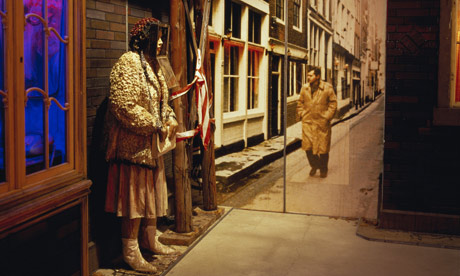
That was Monday - Tuesday was yesterday. I walked down to the National Gallery in the evening to see The Hoerengracht, a new installation based on Amsterdam's red light district. It's somewhere between the world's best A-level art piece and Disney's Pirates of the Carribbean. They have recreated a few streets, complete with bollards, bicycles, street signs, and Amsterdam's famous windows through which girls solicit clients walking past. It's brilliantly tawdry - the girls themselves are all dressed up shop dummies, each placed in a Fassbinder-esque room. You get a real sense of personality from all of them, even little things like the designs of their rooms. Everything is sticky - the installation has been thoroughly glooped, so it resembles something between a car crash and murder scene. Sometimes it looks like tears, other times rain, other times blood. It's uncomfortable, atmospheric, beautiful. In fact, the only thing it didn't inspire me to do was go get myself a prostitute. Even though some of the mannequins were inviting you in, and the act of looking at the art, of course, transformed into audience into unwitting voyeur, it didn't really look appealing. Particularly this woman (can't remember her name - they were all named), who had something horribly desperate about her. I also did some more carol singing in Trafalgar Square, with another churchy charity.

On the way home, Calypso and I appropriated a broken street bollard as found art, and it is now in the hall. That's what students are meant to do, right? Get drunk and pinch stuff? Unfortunately, while Calypso was fairly tipsy, I was both stone sober, and the one technically doing the appropriation. We've lit it up from the inside and it's now pointing up the stairs. Spirita believes, although it is an "effective use of the Space, we should probably recontextualise it on the street". Pretty edge and BarleyThink - get a piece of street junk and transform it into art, then put it back on the street so everyone thinks they're looking at street junk, when actually it's art. Ha! To my mind, however, the thing is obviously beyond repair - the base is misshapen, far from square. It's obviously been hit by a car, and I don't think fibreglass can be recycled. I would sort of like to inform the council that it's missing however. I don't know who I'd phone, though, just like I didn't last week when a hole in the road was SPEWING SMOKE. We have named it Magwitch.

To celebrate it's arrival, we had an impromtu party - lit up the room with sleazy lighting (Hoerengracht was still on the brain), dressed up and put jazz on - starring Spirita as Michael Yorke. After dinner, Calypso and I watched Guns of Navarone. I'd half forgotten how much I adore it. Unfortunately, the disc froze just as our heroes were surrounded by armed Nazis. The DVD player was a free one, so I suppose I shouldn't complain too much, but it was an inconvenient place to stop. We kept going on a laptop, and it occured to me for the first time that I am able to have an accurate guess at the year of a film from the style of violence presented. I've been reading this book by Stephen Prince about "Classical Hollywood Violence", and I must say it's fantastic. Expect a blog about it soon. All about what movies of different eras did or didn't show but from a purely stylistic perspective. This occured to me when Brown stabbed a Nazi, and both characters and the knife were clearly in shot, with no obscuring framing or anything.
From that alone, I figured it couldn't be any earlier than the 60s - and indeed turns out it was 1961.

It also occured to me that, while The Sea Wolves would be exciting - remember, reuniting the key cast of Guns of Navarone and sending them to Portugal? - war movies often tend to be massacres.If either got killed off I would be immoderately distraught,

Twin Peaks continues to be good. We've drawn a map of the characters so we can keep track. I think it's Donna and James on current evidence, but is probably going to be ultimately someone we haven't met. Calypso thinks its Diane.
My random-ethnic-food-sampling quest continues! I haven't yet cooked up the falooda or laveeza, mostly because both require a litre of milk. When am I likely to have a WHOLE LITRE of undrunk milk in the house?

But, joy of joys, this week I discovered frozen spring roll paper. A packet of 30 pastry sheets, the consistancy of beige felt, with which I could replicate the chocolate-banana spring rolls popularised by Ping Pong.

What fun! Spirita christened it "a uniquely Thursday night experiment", alluding to the fact Calypso tends to visit home on Thursday and thus wasn't about to correct my reckless lack of experience. She also suggested a saucepan with a centemeter of oil was the best way to cook my creations. Ten minutes of dodging spitting oil later (See! me dive tackle Vapilla to safety. Imagine! Spirita imitating Zhang Zhi. Conjugate! dire parental warnings to prevent it happening again.), I had produced a plate of most edible creations. The banana and dark chocolate was brilliant - so was the rice and fake-chicken and, joy of joys, the cheesy wantons I had produced. The only downside was they were all still slimey with oil, and tasted like heart attacks.

Still, it's a learning curve. I think next time, I will brush them with oil and oven bake them, to see if the result is less obviously unhealthy. Perhaps the greatest success so far has been the semi-fridgecake I have produced. I left a darkchoc+banana pastry, uncooked, in the fridge where it cooled and grew stiff. Gorgeous, and possibly replicating this technique will provide a great method for portable lunches. Sandwiches tend to disintigrate in my bag, as do wraps.

Yesterday was dubbed "the day of Faily Mc Fail" by Calypso, as I did a one man rendition of Black Hawk Down. My "coms" went down (well, my mobile battery ran out) and it threw the whole day out of kilter. I spent two hours walking up and down hills in Archway and Highgate trying to track down the rest of my "unit", all while being shot at by native militiants (sort of...). Calypso got stranded in Reading by strafing. Unlike Mogadishu, Highgate resembles a Victorian picture postcard. Little red houses, all it needed was robins and snow. I touched the statue of Dick Whittington's cat, which a passerby told me was "lucky". I returned to "base" at the Strand, and was most fortunate to run into Vapilla, then Calypso. So ultimately, the day wasn't a total disaster.

And today has made up for it by being lovely. I finished "The Power and the Glory" by Graham Greene this morning. I love him - a particularly English sort of quiet despair. All his characters are pathetically human - resignation, betrayal and cynicism all over the shot. No one can quite destroy a man the way he can - depressing, but in an entertaining way. "Power and the Glory" is about a rather sinful Catholic priest on the run in Mexico. I confess I sleepwalked through it, and didn't fully appreciate it, but enjoyed it all the same. The End of the Affair is meticulously constructed, to be unpacked by GSCE level students. The constant interplay of "love" and "hate" is beautiful. It's only let down by a third-act twist which requires a huge leap of faith to buy. The Third Man, Brighton Rock and The Quiet American are three of my very favourite films. I also enjoyed his book of short stories. In his youth, Greene attempted suicide several times by Russian Roulette: I take this as a sign that Art, or at any rate Providence, was taking care of him for a higher purpose. If only to produce books which, later, I would love.

And at lunchtime, I spent half an hour carolling at Bond Street station with Chislehurst Methodist Church. I was early to meet Ajax, and they were singing in a particularly querrelous, high-pitched, Methodist manner. I've missed all the carol services for this year and fancied a sing song, so asked if I could join in. I arrived just in time for all my faves. It was very pleasant - anyone can be Christian at Christmas - and religion has been on my mind ever since reading the book this morning. i feel rather wretched that, having not been raised Catholic, I am spared the depths of angst plumbed by Greene, Waugh, Scorcese and the rest. I think I'd rather have the complication of a confusing faith than a quiet, atheist life, if it meant I had something to write about.
This week I saw a Hitchcock film I actually liked - his first, The Lodger, or, A Story of the London Fog, with a live score improvised by Minima. The story is based on the Jack the Ripper murders, and concerns a mysterious "lodger" whom, we begin to suspect, has some very interesting nocturnal activities. There will be spoilers below, but for this very rare silent film you are never going to see. So I advise you keep reading.

I adored it, start to finish, but my feelings exploded into a bit of a wordvomit, part justification and part exploration revolving around Jack the Ripper. My least favourite obsession - I know, in part, where it came from, but I'm not particularly proud of it. The way I see it is: at least I'm honest. And it's not so much the history that fascinates me, as the way the world at large has attempted to make their obsession reasonable. And it's this in turn, I like to tell myself, that makes my interest acceptable. All those ideas are coming out in a splurged, tinged with the reek of academese, but do try and keep up as I think I'm attempting to say something valuable.

There are no footnotes because these are all my ideas, but you can take it as given that many of them have been expressed more eloquently by people with careers.

People love nosying into violent murder. It's hidden between the respectable sheets of the "London Lite", or made "OK" by the ten o'clock news - but secretly, everyone is fascinated. The interesting thing about Jack is the way this fascination is allowed to be public. There are Ripperology conventions, and the fella's had cameos on Twilight Zone, Star Trek, Babylon 5, Smallville, X-Men - even a namecheck in Doctor Who - in a way I can't see Ed Geind doing any time soon.

It's an example of cinema (and more widely, of course, fiction) mediating images and making it "safe". Smoking looks pretty cool on screen, so do car chases, gunfights and all sorts of behavior we should find reprehensible. Another example would be how we can watch the news impassively, almost on autopilot, without engaging with the reality of any of the stories. Poor Saucy Jack has been mediated in this way for a good century now - we are safe from engaging with the real life corpses of five real, dead women because he has been made successively more fictional, more and more safe.

One example of the "fictionalisation" process is the use of Ripperologist terminology. Those five victims are popularly referred to as the "canonical" five, to separate them from other deaths attributed to him (sometimes up to 20). But the use of the word "canonical" is telling - a word which means not only correct, but someone has decided its correct. An aspect of fiction - someone has decided how we're going to pass this story down. Medea kills her children, and all pre-Euripidean versions where the kids make it are non-canonical.

Of course, there's time and decency. And all serial killers go through a version of this - because we are also piecing them together from news reports - but because Mr Jack remained a mystery, there's room for us to write whatever we like straight over the top of him. The Jack we have is a heavily romanticised figure: The Lodger portrays him as beautiful and sad - Gotham by Gaslight makes him maladjusted, but intelligent. This is another way of rendering him "safe" - as Oscar Wilde puts it, "we praise the banker that we may overdraw our account, and find good qualities in the highwayman in the hope that he may spare our pockets. "

The looping together of history and fiction finds it's home in the Gothic Horror genre, and so he inherits many of the vampire traits. Dangerous, but also sexy - aristocratic - villainous, but on some level a heroic social rebel. The Lodger in particular portrays him with waxy pale skin and a huge black cloak, while Anno Dracula reveals he is actually Jack Seward of the original novel. Dracula. The Last Sherlock Holmes Story melanges him with that other great Victorian Gothic figure - as does Exit Sherlock Holmes. The animated Van Helsing preview also takes Jack on - this time, he's actually Mr Hyde. You can bet he's in League of Extraordinary Gentlemen too. Magic and sorcery get their turn also- From Hell figures him as a Freemason trying to...do whatever Freemasons do, Matrix is using the killings to power some sort of super-magic-McGuffin, and Yours Truly, Jack The Ripper has them as an attempt at immortality (more of that later). He's mixed up with Crippen, Spring Heeled Jack and Sweeney Todd - appropriately, those three figures are in turn are real, sort-of real and fictional.

So he also gets constructed as part of the archetypal Gothic-Victorian landscape: taxidermy, heavy mahogany, gas lights, cobbles, shadows, and in particular, fog. The Lodger is subtitled "a Story of the Londern Fog", as if the fog were somehow implicated in all that ripping - similarly the Buffy the Vampire novel which takes him on is called "Blood and Fog". In the Doctor Who novel Matrix, the Fog decends when Jack does. The novel is set in an alternate London where the killings never stopped, ultimately plunging the country into chaos as the paranoia and killing turn into a sort of epidemic:


"Following the Ripper murders, the citizens of London rose up against the authorities who were unable to protect them, and a period of civil unrest followed. Then, during World War One, rumours of atrocities drifted back from the front lines -- and when the shell-shocked veterans returned, something evil returned with them. Ever since, London has been under siege from the walking dead, social order has broken down, and gangs of youths who worship Jack as the new Messiah roam the streets. The Americans took control after the war with Hitler and put London under quarantine, but all they've done is contain the problem"
Army crackdowns, Jacksprites everywhere, zombies and rationing. And fog, lots of fog: in the universe where Jack's spectre never left, neither did the Fog.

The lingering spectre is a powerful image, because it's not altogether incorrect. The fascination hasn't left. Perhaps it's the draw of an unsolved mystery. That's the significance of the fact he was never caught, nor even found - because he hasn't left either. Those novels with immortality attempts are perhaps deeper than they intended to be. Certainly, he's been regarded as the father of the modern serial killer (more because he was the first to be widely reported by a hysterical Victorian newspaper machine). From Hell gives Jack an out-of-body experience through time, where his spirit literally inspires Peter Sutcliffe, Ian Brady and William Blake.

And much like Matrix, From Hell at one point claims that he kickstarted the entire 20th century, and was the culmination of the Victorian period. "Jack" says:


"It is beginning, Netley. Only just beginning. For better or worse, the twentieth century. I have delivered it."

And Alan Moore says:

"the Ripper murders — happening when they did and where they did — were almost like an apocalyptic summary of... that entire Victorian age."


I mean, for goodness sake! Remember what we are actually talking about: one very pathetic fella who diced five women in gory detail. Yet the cling he has on the popular imagination is immense - he was voted "The Worst Briton in History" - when we can'tt even know for sure if he is a Brit.

Ah, all I want is half a year to construct a proper essay on this theme!


As for the film.

I had suspected from the start that the Generic Production Code Thingy would impact the movie's ending. I can't recall exactly what the rules were in 20s Britain, but I assumed it would be similar to America's of the same time. Bad must be punished, and the audience's sympathy must not be with crime. The downbeat ending is a relatively new innovation in screen terms.

In actual fact, the Lodger cops out not once but twice. Our Jack can't get away with it, and is inevitably caught by the police. But then, in a second startling twist, we discover that he's not guilty at all but is an innocent party also tracking the Avenger. Which is pretty limp and unexpected given what's gone before. But by the time this is revealed, the damage has been done. You've already had the thrill factor of seeing a beautiful girl seduced by a monster - the "spectacle", if you like - and of sympathising with a vicious killer, because it's been so heavily hinted it is him throughout. The Lodger has as good as done the crimes - or, by the end of the movie, it doens't matter that he hasn't. It may as well have been him. The shock twist almost makes it all more obvious. IMDb confirms what I'd already guessed: Hitchcock wanted an ambiguous ending to the film, but the studio wouldn't allow it to be implied that the lodger might actually be the murderer. I still think it's pretty ambiguous, or perhaps I just wanted it to be. There are also strong overlaps with Psycho - blondes in bathtubs, rented rooms as dangerous spaces, or spaces disjointed from conventional morality, not to mention twisted sexuality and an innocent on the run.

Innocent. Pah.


A good essay on the Lodger is here:http://www.cinemademerde.com/Essay-Lodger_Hitchcocks_First_Film.shtml


This week continues to be a bit lumpy. Doctor Who rather knocked my chocks out, I think. Typically, when Real things go wrong I have some Fiction to fall back on - but obviously right now, that's not the case, as the Fiction is as bad or worse than anything Real can reasonably throw at me. I suppose there's always Blake's 7, that bastion of love, optimism and happy endings. And lots of bad Real stuff is going down too: everything has gone wrong this week. The highlight was probably almost getting electrocuted. Has my dad mortally offended Morgoth or something?

It doesn't help that I've been set a presentation of perennial emo-fave Nietzsche. I feel like I've finally become a teenager, and am going through my existentialist, t-shirt-icon, pretentiously pessimistic phase. I'm even listening to the Manic Street Preachers.

The Birth of Tragedy - by Mr Nietzsche. I can see the Doctor written all over it. Because of my associative mind, I tend to link up absolutely everything. This time last year, when the news of Tennant's departure came out, I remember reading about Aristotle, pain and fear, catharsis, and why we enjoy watching miserable drama the very next day. Now obviously the topics are related, but in retrospect (lovely Latinate word, that...) it was probably mostly my preoccupations colouring things. In the year which Tarantino and Shakespeare shared my obsessions, I remember a fantastic debate which occured about Reservoir Dogs AND Hamlet simultaneously. I'm sure it made sense at the time - I think I was criticising suspense and second act problems. I suppose no theory of art is comprehensive if it doesn't include low-art as well, and I was most struck with this:

"Because the Apollonian impulses of the Greek tragedians give form to the Dionysian rituals of music and dance, the death of the hero is not a negative, destructive act but rather a positive, creative affirmation of life through art."

Which is what I was trying to express last post. By Dionisian, he means wild, primal, frenzy, suffering, the reality of life. By Apollonian he means contained, light, dreamlike and detatched. His theory for perfect art is that the two should be balanced. On the one hand, I'm handling the full Dionysian brunt of that episode with my emotional response. But my inner Apollonian is very satisfied with the "form" of the thing - the way it mirrors Planet of Fire, the completion of arcs, the evolution of characters. Not sure what to say about the second half though. You'll be able to see me affirming the creative nature of life through art at the bottom of my second bottle and third Kleenex box on Boxing Day.

No one really knows what Nietzsche stands for, aside from a vague idea that he's a miserable sod who killed off God. Having read some I feel myself moved, impressed and with a huge boost to my morale, due to positive and beautiful philosophy. Am I doing this wrong? I feel like I've missed something, or else the universe has done Mr N. a huge disservice all these years. This is Sparknotes' summary:

"For Nietzsche, art is not just a form of human activity but is rather the highest expression of the human spirit. The thrust of the book is well expressed in what is perhaps its most famous line, near the end of section 5: “it is only as an aesthetic phenomenon that existence and the world are eternally justified.” One of Nietzsche’s concerns in The Birth of Tragedy is to address the question of the best stance to take toward existence and the world. He criticizes his own age (though his words apply equally to the present day) for being overly rationalistic, for assuming that it is best to treat existence and the world primarily as objects of knowledge. For Nietzsche, this stance makes life meaningless because knowledge and rationality in themselves do nothing to justify existence and the world. Life finds meaning, according to Nietzsche, only through art. Art, music, and tragedy in particular bring us to a deeper level of experience than philosophy and rationality. Existence and the world become meaningful not as objects of knowledge but as artistic experiences. According to Nietzsche, art does not find a role in the larger context of life, but rather life takes on meaning and significance only as it is expressed in art."
I think you can see why I'd find that appealing. Oscar Wilde said something similar about nature: we only understand it as beautiful because Art has told us a blissful hill is beautiful. In truth, it's scratchy and uncomfortable and there are insects everywhere. And much like my witterings about decay and mundanity being "ugly" purely because we don't expect to find it beautiful.

My whirlwind romance with Nietzche was, however, not to last. Turns out the World was right about him being a misery guts. This was an early work, and he goes on to describe it as:

"badly written, ponderous, embarrassing, image-mad and image-confused, sentimental, saccharine to the point of effeminacy, uneven in tempo, [and] without the will to logical cleanliness"

Which is funny when you consider that would also be a perfect description of your humble authoress. Of course, the whole point of the essay is how Socrates invented rational thinking and therefore destroyed art - a valid point. I wouldn't blame Socrates, but then, with a bit of luck I won't have to give a damn what Socrates thinks very, very soon. More details as they emerge.
I think I've just been rescued.